


XMFH01 vs XMFH02: Choosing a Honeycomb Paper Wrapping Machine
2026-10-20 11:10
The choice between a manual and an automatic honeycomb paper machine starts with one task: bringing opened wrapping paper to the product. A manual dispenser makes that task part of the operator’s pulling motion. A powered machine adds a driven paper feed. Both approaches can belong at a packing bench, but they suit different working rhythms and require different equipment arrangements.
Recycle Paking offers the XMFH01 manual honeycomb paper dispenser and the XMFH02 powered honeycomb wrapping machine. Comparing these specific models gives buyers a clearer decision than choosing equipment simply because it is described as automatic.
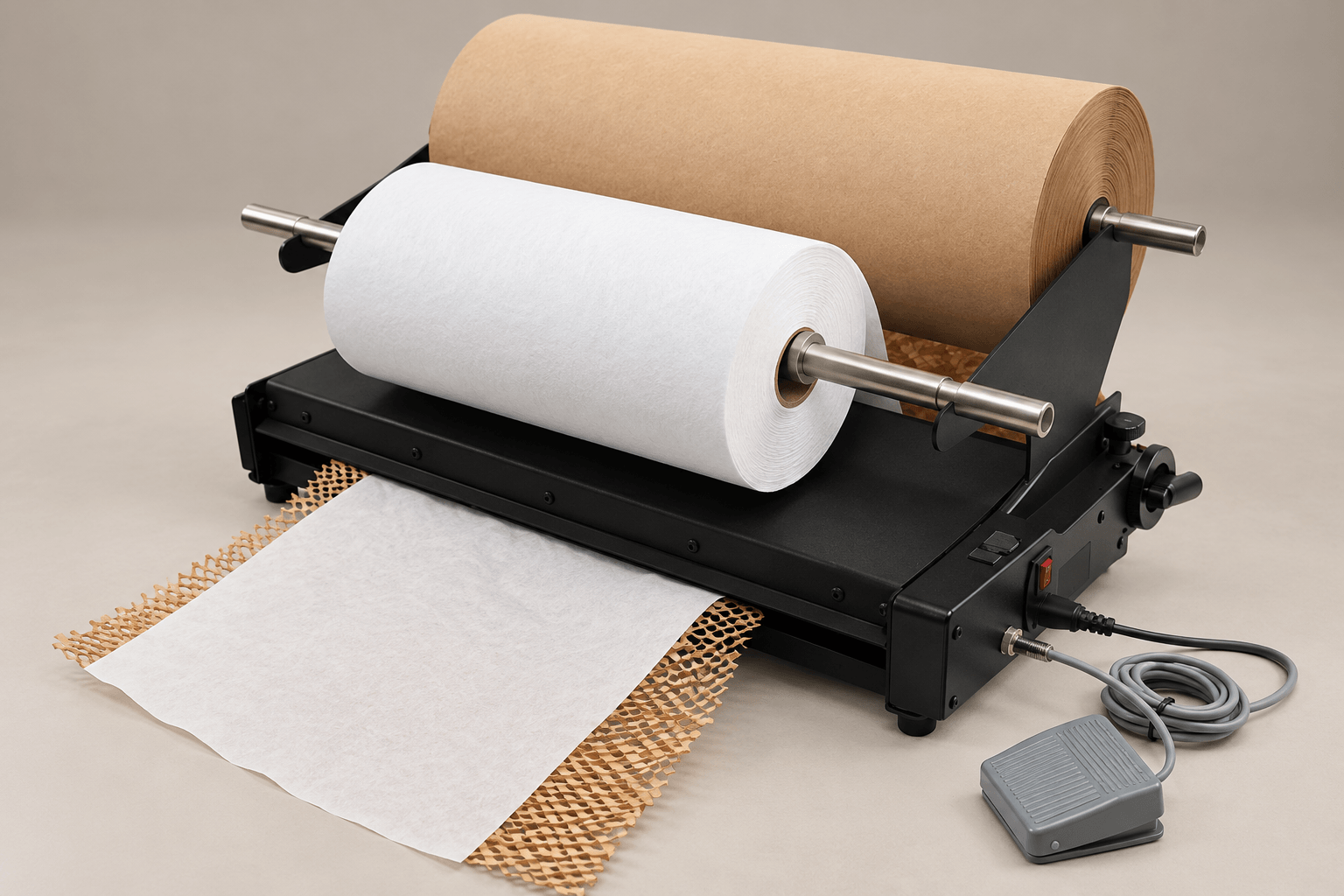
Published equipment differences
| Feature | XMFH01 | XMFH02 |
|---|---|---|
| Paper feed | Manual pull | Powered output |
| Listed machine size | 660 × 240 × 220 mm | 595 × 320 × 243 mm |
| Net weight | 7 kg | 13 kg |
| Published powered feed speed | Not applicable | 8 m/min |
| Rated electrical power | Not listed for this manual model | 150 W |
| Pedal option | Not listed | Optional foot pedal |
The specifications come from the official XMFH01 dispenser page and XMFH02 machine page. The XMFH02 dimensions above are converted from the published centimetre values; these are machine dimensions, separate from shipping-carton dimensions.
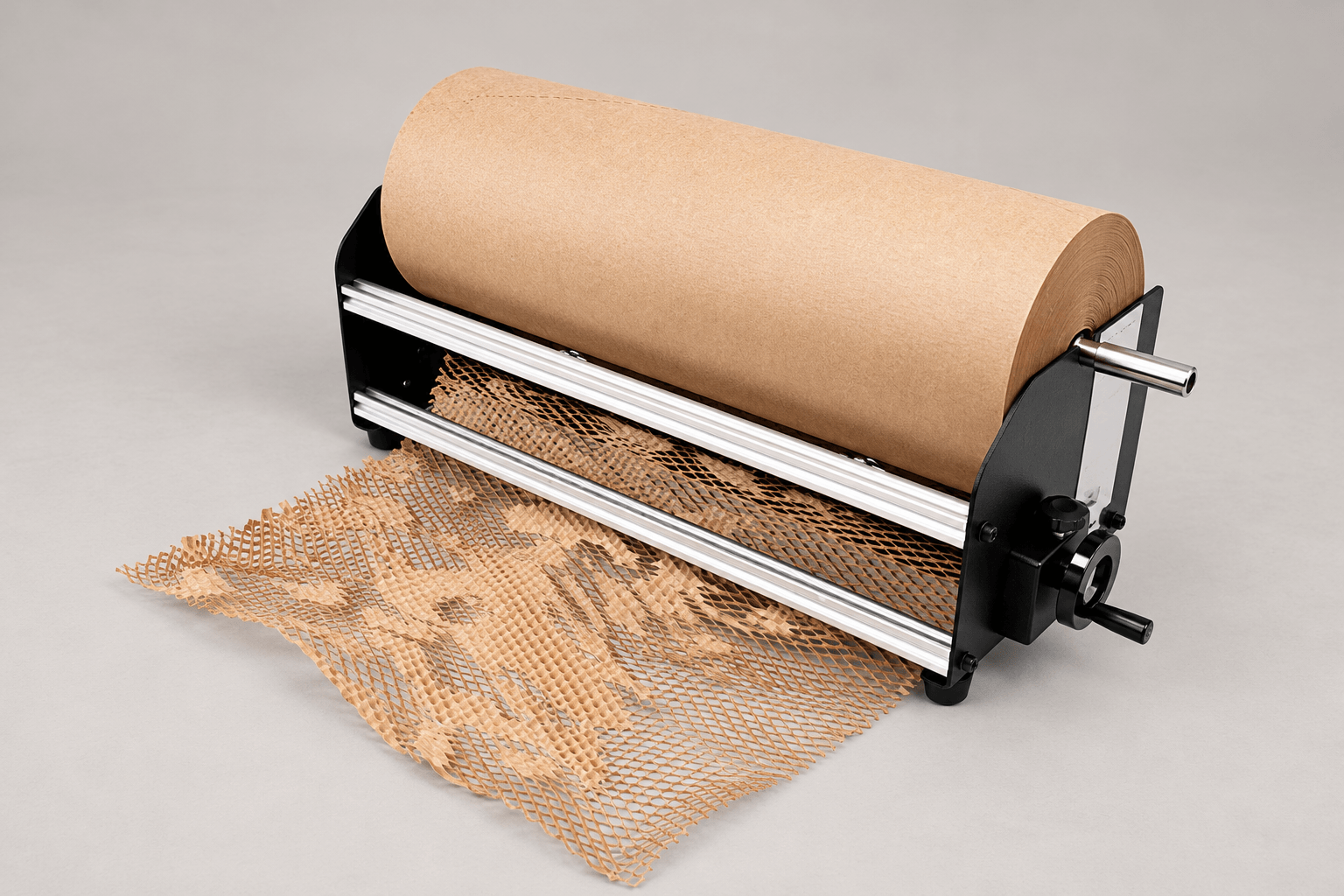
XMFH01: the operator controls paper delivery directly
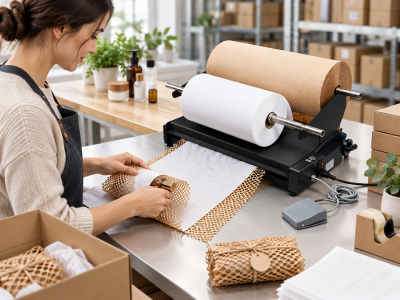
The XMFH01 uses a desktop frame to hold the roll while the operator draws out the honeycomb wrapping paper. Paper delivery follows the hand movement used to prepare the wrap. The packer selects how much to pull for the item, wraps it, and separates the required section by hand. This creates a direct connection between the product being handled and the amount of paper drawn.
That arrangement can suit a retail dispatch bench or an intermittent wrapping position where packing is one of several jobs. The operator may answer an order query, assemble a carton, and then return to wrapping. A manually supplied sheet can fit those pauses naturally. The relevant benefit is control of an occasional task, rather than an assumed daily production threshold.
XMFH02: a motor supplies the wrapping paper
The XMFH02 adds powered paper output. Recycle Paking describes a rotary paper-feed control and a start button, with a foot pedal available as an option. This changes how paper is called forward: the operator can use the machine’s feed function while organizing the wrapping task. The motor supplies paper; product positioning and wrapping remain part of the operator’s work.
Powered feed becomes relevant when drawing paper is a frequent, repeated action at a dedicated station. For example, an operator wrapping a sequence of similarly shaped products can organize a repeatable cycle around paper delivery, product placement, and transfer to the carton. The optional pedal offers another way to request output when that control arrangement suits the sequence.
Plan for the machine, rolls, and wrapping area
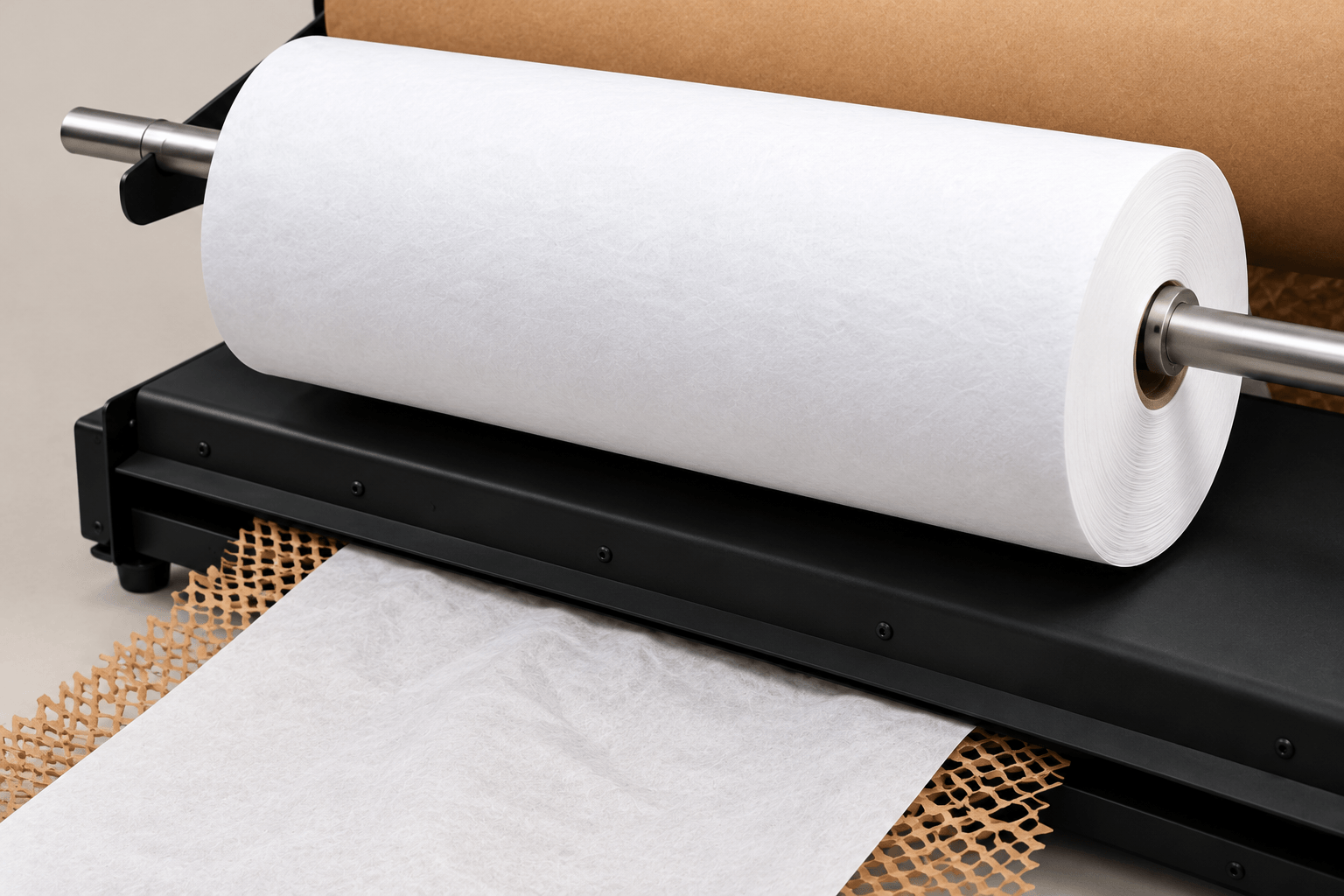
The two models have different listed dimensions and weights, so they should not be treated as interchangeable objects on a bench plan. Leave room for the loaded roll, accessible replenishment, the emerging paper, and the product itself. The front collection area needs enough clear space for a useful section of wrap to open before it is brought around the item.
For a shared workstation, consider how frequently the equipment will be repositioned and where its supply will be kept. For the powered model, include the electrical connection and, when ordered, the pedal cable in that layout. Keep those connections clear of the normal route for cartons and operators. A machine that fits on the tabletop still needs room for the wrapping process around it.
Match the feed method to the work being done
At a bench with irregular orders and frequent pauses, the XMFH01 offers a straightforward manual feed arrangement. At a dedicated wrapping position with repeated demand for paper, the XMFH02 provides a powered alternative. These are application choices: the number of orders alone does not describe how much time an operator spends drawing paper or how the rest of the station is organized.
A practical comparison considers where the operator spends the wrapping cycle. If selecting products, assembling cartons, or arranging several items occupies most of that cycle, powered paper delivery may affect only a small part of the work. Where repeated paper pulling is a substantial activity, motorized output deserves closer attention. This helps connect the equipment choice to a specific task.
What does the XMFH02 speed tell you?
The listed 8 m/min describes the machine’s paper-feed speed. It does not establish how many finished orders one person can wrap in a minute. Item shape, the chosen wrapping method, carton preparation, and handling all remain part of the complete packing cycle. Use the speed to understand the feed mechanism’s role within that cycle.
Choose a specific model for your station
Recycle Paking’s Honeycomb Paper Solution range includes both equipment approaches. For a quotation, contact Recycle Paking with the model you are considering, representative product dimensions, available bench space, and destination country. If choosing the XMFH02, state whether the optional foot pedal is required so the requested configuration is clear.
Related News
Read More >-
![Honeycomb Paper Packaging: A Sustainable and Flexible Solution for Product Protection]()
Honeycomb Paper Packaging: A Sustainable and Flexible Solution for Product Protection
As businesses around the world look for more sustainable ways to package and protect their products, honeycomb paper packaging is becoming an increasingly popular alternative to traditional plastic protective materials. Made primarily from kraft paper, honeycomb paper features a specially cut structure that expands when stretched. Once opened, the paper forms a three-dimensional honeycomb pattern that can wrap around products, absorb impact and help protect surfaces during transportation.
-
![Honeycomb Paper Wrapping Machine: A Sustainable Alternative for Protective Packaging]()
Honeycomb Paper Wrapping Machine: A Sustainable Alternative for Protective Packaging
A Honeycomb Paper Wrapping Machine makes the packaging process faster and easier by dispensing honeycomb kraft paper together with tissue paper. When the kraft paper is stretched, its die-cut structure opens into a three-dimensional honeycomb pattern that can be wrapped around products to provide cushioning and surface protection. For e-commerce businesses, warehouses, retail stores and fulfillment centers, it provides a simple way to combine product protection, packing efficiency and sustainable packaging.
-
![Honeycomb Paper Packaging for Foundations, Serums and Premium Cosmetic Products]()
Honeycomb Paper Packaging for Foundations, Serums and Premium Cosmetic Products
Honeycomb paper packaging, also known as hexagonal honeycomb kraft paper packaging, is a bionic eco-friendly packaging material designed according to the geometric mechanical principle of natural honeycomb structures. It is made of high-strength recycled kraft paper through professional stretching, gluing, compounding, and cutting processes, forming a dense three-dimensional hexagonal hollow structure inside. This unique structural design endows honeycomb paper with extremely strong pressure resistance, impact resistance, buffer energy absorption, and anti-vibration performance, which is far superior to traditional flat paper and ordinary bubble packaging. Different from single-functional packaging materials, honeycomb paper integrates protection, aesthetics, environmental protection, flexibility, and economy, making it highly tailored to the full-scenario packaging needs of high-end cosmetic products such as liquid serums and makeup foundations. It can be processed into honeycomb paper wraps, honeycomb paper liners, customized honeycomb paper trays, integral honeycomb paper boxes, and shaped buffer fillers, realizing all-round personalized packaging protection for cosmetic products of different shapes, volumes, and weights.
-
![The Ultimate Guide to Sustainable Shipping: Why 80gsm Honeycomb Kraft Paper is the Future of Protective Packaging]()
The Ultimate Guide to Sustainable Shipping: Why 80gsm Honeycomb Kraft Paper is the Future of Protective Packaging
In the modern e-commerce landscape, the shift toward sustainable packaging solutions is no longer a choice—it’s a global imperative. As consumers in Europe and North America increasingly demand plastic-free alternatives, businesses are turning to innovative materials that balance environmental responsibility with uncompromising protection. At the forefront of this revolution is the High-Density 80gsm Biodegradable Honeycomb Kraft Paper, a game-changing cushioning material designed to safeguard your products while significantly reducing your carbon footprint.
-
![The Future of Eco-Packaging: Unlocking the Versatility of Honeycomb Paper]()
The Future of Eco-Packaging: Unlocking the Versatility of Honeycomb Paper
The Future of Eco-Packaging: Unlocking the Versatility of Honeycomb Paper In the rapidly evolving world of logistics and e-commerce, the shift away from single-use plastics is no longer just a trend—it is a necessity. As businesses seek sustainable alternatives to traditional bubble wrap and styrofoam, Honeycomb Paper has emerged as the clear frontrunner. Inspired by nature’s most efficient architectural structure, this innovative packaging solution combines superior strength, aesthetic appeal, and environmental responsibility. (Alt Text: Roll of brown kraft honeycomb paper with 3D expanded structure for sustainable packaging) What is Honeycomb Paper? Honeycomb paper is a kraft paper material that is die-cut with a specific pattern. When stretched, it expands into a three-dimensional hexagonal structure (resembling a beehive). This unique geometry creates a cushioning layer that interlocks with itself, trapping air to protect products against impact during transit. Key Applications: Where Can You Use It? Honeycomb paper is incredibly versatile. Here is how modern businesses are utilizing it across various industries: 1. E-Commerce & Retail Shipping For online retailers, speed and protection are paramount. Honeycomb paper is the perfect "all-rounder" for general shipping. It is lightweight, which keeps shipping costs down, yet durable enough to prevent scratches and surface damage on boxed items, books, and clothing. 2. Fragile Goods (Glassware & Ceramics) This is the "killer application" for honeycomb paper. The expanded cells provide excellent shock absorption. Wine & Spirits: It contours perfectly around bottle necks. Home Decor: Ideal for wrapping vases, mugs, and plates. Pharmaceuticals: Protects glass vials and sensitive medical shipments. 3. Beauty & Cosmetics Appearance matters in the beauty industry. Unlike unsightly plastic bubbles, honeycomb paper offers a natural, organic look that enhances the brand image. It is widely used to wrap perfume bottles, skincare jars, and makeup palettes, turning a standard shipment into a premium "unboxing experience." 4. Electronics & Components Static and impact are the enemies of electronics. Kraft paper is naturally anti-static, making honeycomb wrap a safe choice for shipping circuit boards, cables, and small electronic devices without the risk of electrostatic discharge (ESD) associated with some plastics. Why Switch to Honeycomb Paper? Beyond its applications, the operational benefits for your business are significant: No Tape Needed: The 3D structure interlocks with itself. You can simply wrap, twist, and tear. This speeds up the packing process by up to 25% compared to taping bubble wrap. Space Saving: Before expansion, honeycomb paper comes in flat, tight rolls (as seen in the image above). It takes up a fraction of the warehouse space required to store bulky rolls of bubble wrap or bags of packing peanuts. 100% Sustainable: It is fully biodegradable, compostable, and recyclable. Using this material communicates to your customers that your brand cares about the planet. Conclusion Honeycomb paper is more than just packaging; it is a statement. It proves that you don't have to sacrifice protection for sustainability. Whether you are shipping delicate ceramics or rugged industrial parts, this nature-inspired solution offers the resilience you need with the eco-credentials your customers demand. Ready to upgrade your packaging? [Contact Us] today to get a quote on our premium Honeycomb Paper solutions.